Category

Auto

Category

Buying wheels sounds simple at first. You find a style you like, pick the size, and order them. But wheel fitment is where a lot of people get tripped up. A wheel can look perfect and still be completely wrong for the vehicle if the basic fitment details do not match.

That is why understanding a few key terms matters before you buy anything. The good news is, wheel fitment is not as confusing as it first seems. Once you understand bolt pattern, offset, hub bore, and lug seat type, you can make much better choices and avoid expensive mistakes.

Let’s start with bolt pattern because this is one of the first things that has to match.

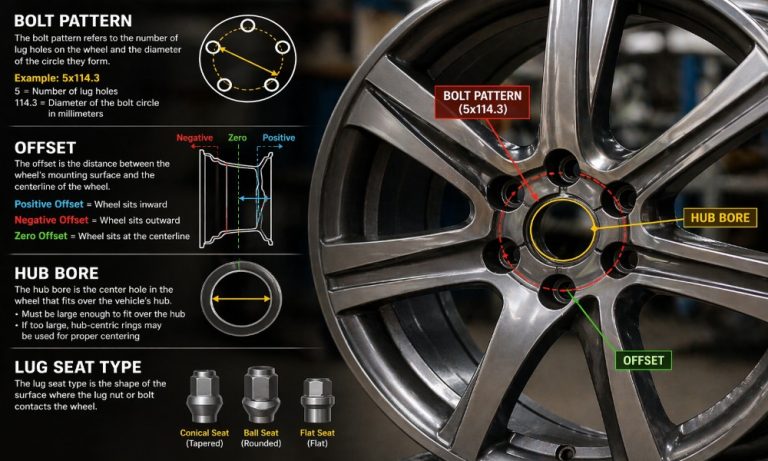
Bolt pattern refers to the number of lug holes on the wheel and the diameter of the circle they form. You will usually see it written in a format like 5×114.3 or 6×139.7. The first number tells you how many lug holes there are. The second number tells you the diameter of the bolt circle in millimeters.

So, if a wheel is listed as 5×114.3, that means it has five lug holes and the circle they form measures 114.3 mm across. This has to match your vehicle exactly. Close does not count here. A wheel with the wrong bolt pattern simply will not mount correctly, and trying to force it is a bad idea. It can cause vibration, poor seating, or even a dangerous situation on the road.

Next is offset, which is probably one of the most misunderstood parts of wheel fitment.

Offset is the distance between the wheel’s mounting surface and the centerline of the wheel. It tells you how far inward or outward the wheel sits once installed. Offset is usually measured in millimeters and can be positive, zero, or negative.

A positive offset means the mounting surface is closer to the outside face of the wheel. This usually places the wheel more inward toward the suspension. A negative offset means the mounting surface is closer to the inside of the wheel, which pushes the wheel farther outward. Zero offset means the mounting surface sits right at the centerline.

Why does this matter so much? Because the wrong offset can affect clearance, handling, and appearance. If the offset is too high, the wheel may sit too far inward and rub suspension parts or inner fenders. If it is too low, the wheel may stick out too far and contact the outer fender. It can also change steering feel and put extra stress on wheel bearings over time.

That is why people should not choose wheels based only on style and diameter. Offset plays a huge role in whether the wheel actually works on the vehicle.

Then there is hub bore, which is another important detail that often gets overlooked.

The hub bore is the hole in the center of the wheel that fits over the vehicle’s hub. This measurement needs to be large enough to fit over the hub, but not so large that the wheel cannot center properly unless hub-centric rings are used.

A wheel with a hub bore that is too small simply will not fit over the hub. A wheel with a hub bore that is too large may still bolt on, but it may not sit centered unless the correct rings are installed. That can lead to vibration, especially at highway speed.

Some vehicles are hub-centric, which means the hub helps center the wheel. Others rely more on the lug hardware, but even then, proper fitment still matters. A lot. In general, matching the hub bore correctly helps create a smoother and more secure installation.

Now let’s talk about lug seat type, because this is one of those details that sounds minor until it causes a real problem.

Lug seat type refers to the shape of the area where the lug nut or lug bolt contacts the wheel. The most common types are conical seat, ball seat, and flat seat. These are not interchangeable unless the wheel is specifically designed for more than one type, which is not usually the case.

A conical seat has a tapered shape. A ball seat has a rounded profile. A flat seat has a flat mounting surface and often uses a washer. The lug hardware must match the seat type of the wheel. If it does not, the wheel may not clamp properly. That can cause loosening, vibration, or damage to the wheel mounting surface.

This is where people sometimes run into trouble when reusing factory lug nuts with aftermarket wheels. Just because the thread size is correct does not mean the seat type is correct too. Both need to match.

When looking at wheel fitment as a whole, it helps to think of these details as a package. Bolt pattern tells you whether the wheel can mount. Offset tells you where it will sit. Hub bore tells you whether it will center correctly. Lug seat type tells you whether the hardware will secure it the right way.

And honestly, one wrong detail can ruin the whole setup.

It is also worth remembering that wheel width and diameter still matter too, even though they are not the focus here. A wheel can have the correct bolt pattern and hub bore, but still rub if the width and offset combination is wrong. Fitment always works best when all measurements are looked at together, not one at a time.

For anyone shopping for wheels, the safest approach is to verify every spec before buying. Check your vehicle’s factory fitment. Compare that to the wheel specs. Make sure the bolt pattern matches exactly. Confirm the offset range works for your setup. Verify the hub bore. And do not forget the lug seat type and hardware.

Wheel fitment might seem overly technical at first, but it really comes down to getting the basics right. Once you understand these terms, you can shop with more confidence and avoid the guesswork. That matters because the right wheel should do more than look good. It should fit properly, drive smoothly, and keep the vehicle safe on the road.

This post was written by a professional at Tires2Go Florida. Tires2Go Florida is a trusted automotive service center located in Pinellas Park, Florida, serving drivers across St. Petersburg, Tampa, Clearwater, and Largo. Our certified auto mechanic Clearwater FL handle tire and wheel replacement, brakes in Pinellas Park, suspension repairs, oil changes, wheel alignments, tire balancing, and road force balancing. We also specialize in ADAS calibration, suspension modifications, lift kits, and lowering kits using quality parts and modern diagnostic equipment. From routine maintenance to advanced automotive services, Tires2Go Florida provides dependable solutions and tires for sale for vehicles throughout the Tampa Bay area.

Brake noises are easy to notice, and they should never be ignored. Two of the most common sounds are squeaking and grinding. They may seem similar at first, but they can mean very different things.

Understanding the difference can help you know whether your vehicle needs a simple inspection or urgent repair.

What Squeaking Brakes Usually Mean

Squeaking brakes often make a high-pitched sound when you press the brake pedal. Sometimes the sound is light. Other times, it can be loud and annoying.

Common causes include:

  • Worn brake pads
  • Dust or dirt on the brake parts
  • Moisture after rain or washing
  • Low-quality brake pads
  • Brake pad wear indicators
  • Glazed brake pads or rotors

In some cases, squeaking is not an emergency. For example, light squeaking on a cold or wet morning may go away after a few stops. But if the sound keeps coming back, it should be checked.

Many brake pads have small metal wear indicators. These are designed to squeak when the pads are getting thin. It is like a warning sound telling you the brakes need attention soon.

How Urgent Are Squeaking Brakes?

Squeaking brakes are usually a “check soon” problem. You may still be able to drive, but you should not wait too long.

If the squeaking happens every time you brake, schedule an inspection. Replacing brake pads early can help protect the rotors and keep repair costs lower.

What Grinding Brakes Usually Mean

Grinding brakes are more serious. This sound may feel rough, harsh, or metallic. It can happen when the brake pads are completely worn down and metal parts are rubbing against each other.

Common causes include:

  • Brake pads worn down to the metal
  • Damaged brake rotors
  • Debris stuck in the brake system
  • Caliper problems
  • Severe rust on brake parts

Grinding often means the braking system is already being damaged. If metal touches metal, the rotors can become scratched or warped. This can make repairs more expensive.

How Urgent Are Grinding Brakes?

Grinding brakes are urgent. You should stop driving as soon as it is safe and have the brakes inspected.

Driving with grinding brakes can reduce stopping power. It can also damage other brake parts. In some cases, it may become unsafe to drive.

If the grinding sound is loud, constant, or comes with vibration, burning smells, or poor braking, do not ignore it.

Other Warning Signs to Watch For

Brake noise is not the only sign of trouble. You should also pay attention to:

  • Brake pedal feels soft or spongy
  • Car pulls to one side when braking
  • Steering wheel shakes while braking
  • Brake warning light turns on
  • Burning smell near the wheels
  • Longer stopping distance

These signs may mean your brakes need immediate attention.

Why Early Brake Repairs Matter

Brake repairs are usually cheaper when problems are caught early. Replacing worn pads is often simpler than replacing damaged rotors, calipers, or other parts.

More importantly, brakes are one of the most important safety systems in your vehicle. If they are not working well, your ability to stop quickly can be affected.

Final Thoughts

Squeaking brakes usually mean your brakes need attention soon. Grinding brakes usually mean the problem is more serious and should be checked right away.

Do not wait for brake noise to get worse. A quick inspection can help protect your vehicle, lower repair costs, and keep you safer on the road.

This post was written by a professional at Tires2Go Florida. Tires2Go Florida is a trusted automotive service center located in Pinellas Park, Florida, serving drivers across St. Petersburg, Tampa, Clearwater, and Largo. Our certified mechanics handle auto repair Clearwater, tire and wheel replacement, brake service, suspension repairs, oil changes, wheel alignments, tire balancing, and road force balancing. We also specialize in ADAS calibration, suspension modifications, lift kits, and lowering kits using quality parts and modern diagnostic equipment. From routine maintenance to advanced automotive services, Tires2Go Florida provides dependable solutions and tires for sale for vehicles throughout the Tampa Bay area.

Buying a used car is just the beginning of the story. What happens after you drive off the lot determines whether that vehicle serves you reliably for years or becomes a source of expensive stress. Van Nuys drivers face specific challenges: stop-and-go traffic on the 405 and 101 corridors, intense summer heat that pushes cooling systems and tires to their limits, and dusty conditions that clog air filters faster than in cooler climates. With the right habits, a well-chosen pre-owned vehicle can give you years of dependable service.

Oil Changes: The Foundation of Engine Health

Engine oil is the lifeblood of your vehicle, and neglecting it is the fastest way to shorten your engine’s life. Most modern vehicles can go between 5,000 and 7,500 miles between oil changes using conventional oil, while synthetic oil extends that interval to 10,000 miles or more. Check your owner’s manual for the specific interval and oil grade recommended for your vehicle. In Van Nuys’s heat, running slightly fresher oil is never a bad idea. Always change the oil filter at the same time as the oil.

Tire Maintenance: Your Safety Contact with the Road

Check tire pressure monthly. Van Nuys summer heat causes air to expand in tires, while cooler months cause pressure to drop. Under-inflated tires wear unevenly and reduce fuel efficiency; over-inflated tires provide less traction. Rotate your tires every 5,000 to 7,500 miles for even wear across all four wheels, and have your alignment checked annually or whenever your car pulls to one side. Most used car tires are partway through their lifespan, so have them evaluated soon after purchase.

Brake System Inspections

Los Angeles traffic means frequent braking, which accelerates brake pad and rotor wear considerably. Brake pads should be inspected at every oil change. Most pads have a wear indicator that creates a squealing sound at minimum thickness. Ignoring it leads to metal-on-metal contact that turns a $150 pad replacement into a $400 to $600 rotor job. Brake fluid should be flushed every two years, as it absorbs moisture that lowers its boiling point and reduces braking effectiveness.

Cooling System Care for Southern California Heat

The cooling system is under tremendous stress in the San Fernando Valley’s summer temperatures. Coolant should be flushed every 30,000 miles or two to five years, depending on type. Check the coolant level monthly and inspect its color. Discolored or murky coolant indicates contamination. Inspect radiator hoses for soft spots, cracking, or swelling. A coolant system failure in 100-degree Valley heat can cause rapid overheating and permanent engine damage within minutes.

Air Filter Replacement

Van Nuys has its share of dust and airborne particles, and a clogged air filter restricts engine airflow, reducing power and fuel economy. Engine air filters typically need replacement every 15,000 to 30,000 miles, though dusty urban environments can shorten that interval. Cabin air filters should be replaced every 15,000 miles or annually. Both are inexpensive and often owner-replaceable; keeping them fresh makes a noticeable difference in performance and interior air quality.

Transmission and Fluid Checks

Transmission fluid, power steering fluid, and brake fluid all have replacement intervals that are easy to miss. When you purchase a pre-owned vehicle, ask your mechanic to check the condition and level of all fluids as part of an initial service inspection. Working with a knowledgeable used car dealer in Van Nuys that offers post-purchase service support can help you establish a complete service baseline, especially if the vehicle’s prior maintenance history is incomplete.

Battery and Electrical System

Car batteries in extreme heat degrade faster than in moderate climates. Most batteries last three to five years, but Van Nuys summers can reduce that lifespan. Have your battery tested annually once it reaches three years old. Watch for warning signs: slow engine cranking, dimming headlights, or erratic electronics. Keep a battery jump pack in your vehicle as a practical precaution.

A pre-owned vehicle maintained with care will reward you with thousands of trouble-free miles. In Van Nuys’s demanding driving environment, the difference between a car that lasts and one that fails prematurely almost always comes down to maintenance discipline. Follow this checklist, stay ahead of your service intervals, and your used car purchase will be one of the best financial decisions you have made.

Clear visibility plays an important role in safe driving. Small damage to the front glass often begins without warning. A tiny chip may grow quickly during normal road use. Many drivers notice such issues only after the crack spreads. Reliable services such as Envision Auto Glass auto glass replacement often help restore clear visibility when damage becomes serious. Understanding the reasons behind glass damage helps drivers act quickly before the problem worsens.

Road Debris Impact on Front Glass

Loose objects on highways frequently strike vehicle glass surfaces. Even a small stone can create sudden chips.

  • Flying gravel thrown by moving vehicles often strikes glass suddenly
  • Construction debris scattered across roads may cause unexpected surface cracks
  • Small stones lifted by tires can chip front glass instantly
  • Loose pavement particles sometimes bounce upward toward the vehicle’s glass surface

Road debris remains one of the most frequent reasons for sudden glass damage.

Improper Cleaning or Surface Pressure

Incorrect cleaning habits sometimes damage delicate glass surfaces. Excessive force may weaken thin outer layers.

Using rough materials may scratch protective layers. Hard pressure during cleaning may enlarge existing chips. Chemical cleaners sometimes weaken structural strength. Gentle methods keep glass surfaces safe. Careful maintenance helps prevent accidental surface damage.

Weather-Related Pressure on Glass Surface

Environmental forces can affect glass durability over time. Heavy storms or strong winds sometimes place pressure on vehicle surfaces.

  • Hail impact during severe storms can break or chip glass quickly
  • Strong wind may carry sharp debris toward the front glass surface
  • Rapid temperature drop during storms increases structural stress risk
  • Ice buildup during cold nights weakens the outer glass layer gradually
  • Frozen moisture expanding on the surface may create hidden pressure cracks
  • Sudden sunlight after cold exposure causes fast glass expansion
  • Extreme heat trapped inside parked vehicles stresses glass edges
  • Long exposure to harsh climate weakens structural resistance over time

Weather conditions remain an important factor in glass deterioration.

Poor Installation or Alignment Issues

Incorrect installation sometimes affects long term durability. Misaligned glass creates uneven pressure along edges. Small gaps may allow dust or moisture infiltration.

Proper alignment ensures balanced support. Weak sealing may allow vibrations to spread cracks faster. Skilled installation improves long term resistance. Accurate fitting protects glass integrity.

Quality Glass Replacement Standards Matter

Material quality strongly influences durability. High-grade glass withstands environmental pressure better. Proper sealing prevents hidden stress points.

Drivers often choose services such as Envision Auto Glass auto glass replacement when severe damage appears. Quality materials improve structural strength. Correct fitting reduces vibration impact. Reliable replacement restores safety visibility.

Frequently Asked Questions

  • What causes most windshield chips? Small stones thrown from moving tires cause many sudden chips.
  • Can small cracks spread quickly? Yes, temperature changes may enlarge chips rapidly.
  • Does the weather affect glass durability? Extreme heat or cold can weaken structural strength.
  • Should minor damage be repaired quickly? Early repair prevents spreading across the entire glass surface.
  • How can drivers reduce glass damage risk? Maintain distance from heavy vehicles carrying loose debris.

Early Attention Prevents Larger Problems

Glass damage often begins as a tiny mark. Small chips can expand when ignored. Environmental pressure and road vibration may worsen the problem quickly. Timely repair protects structural stability, visibility, and safety. Careful inspection combined with proper repair solutions ensures clear driving conditions while preventing costly replacement later.

Few cars have the same lasting popularity as the Ford Mustang. First introduced in the 1960s, this car quickly became a symbol of freedom, speed, and personal style. Over the years, it has appeared in movies, racing events, and street culture, making it one of the most recognised classic cars in the world. Customising a classic Mustang allows you to enjoy its vintage charm while adding modern comfort and performance.

The first step in customising a Mustang is choosing the right model, and following Mustang restoration best practices starts with understanding the strengths of each generation. Each generation has its own personality. Early models from the mid-1960s are especially popular because of their simple design and lightweight body. These cars are easier to modify and have strong support for replacement parts. Their clean engine layout also makes it easier to upgrade to a more powerful modern engine, which is why classics like the Ford Mustang remain a favourite among restorers.


Models from the late 1960s offer a stronger and more muscular look. They usually have more space under the hood, which allows for bigger engines and better suspension systems. These versions are a good choice for people who want a balance between classic style and modern performance. Early 1970s models have a bold design and a stronger body structure. They are slightly heavier but are great for high-power builds or eye-catching show cars.

When selecting your base car, it is important to consider the original engine and structure. A car that originally came with a smaller engine might need extra reinforcement if you plan to install a more powerful one. Conversely, a factory V8 model offers a better starting point for performance upgrades. Picking the right base car will influence cost, compatibility, and long-term value.

Modern upgrades are a huge part of customising a classic Mustang. Many owners replace the original engine with a newer, more reliable one to increase horsepower and improve fuel efficiency. Pairing it with a modern transmission can make the car smoother and easier to drive. Suspension upgrades are also important. Improved suspension systems help the car handle better and provide a more comfortable ride. Modern disc brakes add safety and stronger stopping power.

The interior can also be upgraded while keeping a vintage look. Many builders choose high-quality seats, improved sound systems, and updated dashboard features. Modern technology, such as Bluetooth or navigation, can be added in a way that still respects the car’s classic design. This creates a driving experience that feels both nostalgic and comfortable.

Exterior design is where you can truly show your personality. Custom paint colours, racing stripes, or polished chrome details can give the car a unique style. Wheels and ride height also change the overall look. Larger wheels and a lowered stance create a sporty appearance, while classic wheel designs maintain a traditional feel.

Customising a classic Mustang is about more than speed or appearance. It is about creating a car that reflects who you are. By combining vintage style with modern upgrades, you can build a vehicle that honours its history while performing confidently on today’s roads.

You’ve just picked up your new performance car. Whether it’s a Volkswagen Golf R, a Toyota Supra, or a BMW M3, modern vehicles are engineering marvels. However, straight from the showroom floor, they almost all suffer from the same problem: they are too quiet and too restricted. Manufacturers must comply with strict global noise regulations (like EU strictures) and cost constraints, often leaving the car feeling “corked up.”

For enthusiasts looking to start their modification journey, the options can be overwhelming. Should you start with an ECU tune? A cold air intake? For the vast majority of drivers in the UAE, the answer is a Cat-Back Exhaust system. It sits in the “Goldilocks” zone—safer than a tune, more impactful than an intake, and essential for the driving experience.

The “First Mod” Dilemma: Intake vs. Tune vs. Exhaust

Why choose an exhaust over the other common first steps?

  • Cold Air Intake (AED 1,500 – 3,000): While cheaper, intakes alone often provide minimal gains without a tune. In the dusty UAE climate, open filters can also increase maintenance requirements.
  • ECU Tune (AED 3,000+): Offers the most horsepower per dirham, but carries the highest risk. It almost certainly voids the powertrain warranty and, if done poorly, can damage the engine in high heat.
  • Cat-Back Exhaust: Offers immediate sound gratification, modest performance gains, and is generally warranty-friendly as it is a “bolt-on” part that doesn’t alter the ECU software.

What is a Cat-Back? (The Technical Side)

A car’s exhaust consists of headers, a downpipe (containing the primary catalytic converter), and the rear section. A “Cat-Back” replaces everything after the catalytic converter—typically the mid-pipe, resonator, muffler, and tips.

Because it leaves the factory catalytic converter in place, it does not trigger a Check Engine Light (CEL) and keeps the car emissions-compliant.

Real-World Gains: What to Expect

Don’t be fooled by marketing claiming “+50HP.” Realistically, a Cat-Back system on a modern turbo car provides:

  • Horsepower: +5 to +15 WHP (Wheel Horsepower) on stock tuning.
  • Throttle Response: Improved flow reduces backpressure, allowing the turbo to spool faster.
  • Weight Reduction: Factory systems use heavy, thick mild steel. Aftermarket systems use T304 Stainless Steel or Titanium. On a Nissan GT-R or BMW M4, swapping to a premium system can save 10kg to 20kg of weight.

Selecting the Right System for the UAE

The market is flooded with options. Installing a high-quality cat back exhaust is often the most rewarding upgrade for enthusiasts, but choosing the wrong one can lead to headaches.

1. Brand Hierarchy & Budget

  • Entry Level (AED 3,500 – 6,000): Brands like Cobra Sport or Scorpion. Great sound, good stainless steel, but simpler muffler designs that might have some highway drone.
  • Mid-Range (AED 7,000 – 12,000): Brands like Milltek, Remus, or Borla. Excellent fitment, sophisticated tone, and often include valved options that integrate with factory sport buttons.
  • High-End (AED 15,000+): Akrapovič or Capristo. Often made of Titanium or Inconel. These offer the biggest weight savings, carbon fiber tips, and a distinct, exotic pitch.

2. The Drone Factor

“Drone” is a resonant frequency that vibrates the cabin at cruising speeds (usually 120 km/h on Sheikh Zayed Road). In a daily driver, this is unbearable. Look for systems with Helmholtz resonators designed to cancel out these specific frequencies.

Navigating RTA Regulations & GCC Travel

In the UAE, the visual modification of an exhaust is generally accepted if it doesn’t pose a safety risk, but noise is the deciding factor.

  • The Decibel Limit: While enforcement varies, the general rule of thumb for RTA passing is staying under 95dB at 3,000 RPM (stationary).
  • Valved Systems: This is the smartest buy for the GCC. A valved system allows you to keep the exhaust quiet (stock volume) when entering residential areas or passing police patrols, and open it up on the highway.
  • Fines: Excessive noise can result in a fine of AED 2,000 and 12 black points for “driving a noisy vehicle.”

Installation: DIY or Pro?

While a Cat-Back is “bolt-on,” professional installation is highly recommended in the UAE. High humidity near the coast means flange gaskets must be sealed perfectly to prevent leaks. Furthermore, aligning the tips perfectly in the bumper cutouts requires patience and adjustable hangers that professional shops possess.

Conclusion

A Cat-Back exhaust transforms a car from an appliance into a machine with a soul. It provides the sound that matches the speed, saves weight, and prepares your car for future power upgrades. By choosing a reputable brand and sticking to valved options, you can enjoy the roar of performance without the fear of fines. It is the definitive first step in building a car that is truly yours.

ECU tuning is a popular upgrade for drivers who want better performance from their vehicle. In San Antonio, many drivers choose ECU tuning to improve power, throttle response, and overall driving feel. Before moving forward, it’s important to understand the gains, risks, and what the process involves.

What Is ECU Tuning?

The ECU, or Engine Control Unit, is the computer that controls how your engine runs. It manages fuel delivery, timing, and other key functions. ECU tuning adjusts these settings to improve performance. Tuning can be done through software changes without modifying engine parts.

Performance Gains You Can Expect

ECU tuning can deliver noticeable improvements. Many drivers experience better acceleration, smoother power delivery, and improved throttle response. In some cases, tuning can also improve fuel efficiency during normal driving. Gains depend on the vehicle, engine condition, and tuning quality.

Common Reasons Drivers Choose ECU Tuning

Drivers often choose ECU tuning to:

  • Increase horsepower and torque
  • Improve drivability
  • Match engine settings to aftermarket parts
  • Restore performance lost over time

Tuning helps the engine work more efficiently when done correctly.

Understanding the Risks

ECU tuning does come with risks if not handled properly. Poor tuning can cause engine stress, overheating, or drivability issues. Using untested software or skipping diagnostics increases the chance of problems. This is why professional tuning matters.

Vehicle Health Comes First

Before tuning, the engine must be in good condition. Issues like misfires, worn sensors, or transmission problems should be addressed first. Tuning a vehicle with existing problems can make issues worse.

Extended Warranty Considerations

Many San Antonio drivers have extended warranties. ECU tuning may affect coverage depending on the plan. Documentation, diagnostics, and proper procedures matter when working with warranty companies. Educational blogs about tuning and warranty processes help drivers understand what to expect before making changes.

Why ASE Certification Matters

ASE-certified technicians understand engine systems, diagnostics, and safe performance limits. Their training helps ensure tuning is done responsibly. This reduces risk and protects long-term reliability.

What to Expect from a Professional Tune

A proper ECU tune includes diagnostics, testing, and post-tune checks. Results should feel smooth, controlled, and safe—not aggressive or unstable.

Vigorous Automotive Services Tunes with Confidence

At Vigorous Automotive Services, we help San Antonio drivers understand ECU tuning clearly before any work begins. We address customer concerns, explain gains and risks, and back our work with an ASE-certified team. We also work as a trusted repair partner for extended warranty companies and provide helpful blog resources to guide decisions. With careful tuning and professional support, we deliver performance you can feel and reliability you can trust.

This post was written by a professional at Vigorous Automotive Services. Vigorous Automotive Services is your go-to choice for car performance shops in San Antonio. We specialize in everything from suspension lowering shops near you to high-performance car shops near you, offering expert repairs, upgrades, and maintenance. Enjoy free multi-point inspections, virtual consultations, and flexible scheduling—even after hours. Call or book online today for reliable, affordable auto care you can trust! Click here to learn more!

Few cars have the same lasting popularity as the Ford Mustang. First introduced in the 1960s, this car quickly became a symbol of freedom, speed, and personal style. Over the years, it has appeared in movies, racing events, and street culture, making it one of the most recognised classic cars in the world. Customising a classic Mustang allows you to enjoy its vintage charm while adding modern comfort and performance.

The first step in customising a Mustang is choosing the right model, and following Mustang restoration best practices starts with understanding the strengths of each generation. Each generation has its own personality. Early models from the mid-1960s are especially popular because of their simple design and lightweight body. These cars are easier to modify and have strong support for replacement parts. Their clean engine layout also makes it easier to upgrade to a more powerful modern engine, which is why classics like the Ford Mustang remain a favourite among restorers.

Models from the late 1960s offer a stronger and more muscular look. They usually have more space under the hood, which allows for bigger engines and better suspension systems. These versions are a good choice for people who want a balance between classic style and modern performance. Early 1970s models have a bold design and a stronger body structure. They are slightly heavier but are great for high-power builds or eye-catching show cars.

When selecting your base car, it is important to consider the original engine and structure. A car that originally came with a smaller engine might need extra reinforcement if you plan to install a more powerful one. Conversely, a factory V8 model offers a better starting point for performance upgrades. Picking the right base car will influence cost, compatibility, and long-term value.

Modern upgrades are a huge part of customising a classic Mustang. Many owners replace the original engine with a newer, more reliable one to increase horsepower and improve fuel efficiency. Pairing it with a modern transmission can make the car smoother and easier to drive. Suspension upgrades are also important. Improved suspension systems help the car handle better and provide a more comfortable ride. Modern disc brakes add safety and stronger stopping power.

The interior can also be upgraded while keeping a vintage look. Many builders choose high-quality seats, improved sound systems, and updated dashboard features. Modern technology, such as Bluetooth or navigation, can be added in a way that still respects the car’s classic design. This creates a driving experience that feels both nostalgic and comfortable.

Exterior design is where you can truly show your personality. Custom paint colours, racing stripes, or polished chrome details can give the car a unique style. Wheels and ride height also change the overall look. Larger wheels and a lowered stance create a sporty appearance, while classic wheel designs maintain a traditional feel.

https://www.youtube.com/watch?v=fBDc77HWd7U

Customising a classic Mustang is about more than speed or appearance. It is about creating a car that reflects who you are. By combining vintage style with modern upgrades, you can build a vehicle that honours its history while performing confidently on today’s roads.

I work with diesel topics often enough to know that most people reading this already understand the basics. You know cold fuel causes problems. You know injectors need protection. You want your engine to start, idle clean, and stay reliable when temperatures drop. My role here is to help you think clearly about diesel additives, how to judge them, and why certain options stand out based on formulation and track record.

When I evaluate products, I focus on how they perform across real conditions, not labels or claims. That includes how well they prevent gelling, how they handle water, how they protect injectors, and whether they stay safe for modern emissions systems. Early in that process, I often point people toward the best diesel anti gel options that solve multiple fuel problems at once instead of stacking additives that fight each other.

This guide walks you through diesel additives, diesel lubricity additives, anti-gel diesel additives, and how to judge what belongs in your tank.

Why Diesel Additives Matter Year Round

Diesel fuel changes with temperature, storage time, and blend type. Even clean fuel can degrade once it sits or encounters moisture. Additives exist to control those changes before they turn into mechanical problems.

A solid diesel additive should help with:

  • Fuel stability during storage
  • Water control to reduce corrosion and filter icing
  • Injector cleanliness
  • Lubrication for pumps and injectors
  • Cold weather flow protection

I look for products that address these areas without relying on alcohol or harsh solvents. Those ingredients can dry seals, reduce lubricity, and create long term issues.

Understanding Diesel Lubricity Additives

Modern diesel engines depend on fuel for lubrication. Ultra low sulfur diesel removed much of that natural protection. That makes lubricity additives critical, not optional.

A diesel lubricity additive should protect:

  • High pressure fuel pumps
  • Injector tips
  • Upper cylinder components

I pay close attention to measured lubricity improvement, not vague promises. Products like Howes Diesel Defender stand out here because they deliver significantly higher lubricity levels than many alternatives while also cleaning injectors using detergent technology designed for diesel systems.

Cleaner injectors improve spray patterns. Better spray patterns improve combustion. That leads to smoother operation, lower emissions, and improved fuel economy.

What an Anti-Gel Diesel Additive Must Do

Cold weather separates effective products from weak ones. Wax crystals form as fuel cools. If they grow unchecked, filters clog and fuel stops flowing.

A proper anti-gel diesel additive must:

  • Prevent wax crystals from forming
  • Keep fuel flowing through filters
  • Work at very low temperatures
  • Remain safe for biodiesel blends

I avoid additives that rely on alcohol. Alcohol can create short term flow improvements but often causes water separation issues later. Non-alcohol formulas that remove water safely offer better protection across a full winter season.

Howes Diesel Treat is widely recognized in this space because it combines anti-gel protection, water removal, lubricity, and fuel conditioning in one formula. That approach reduces the need to mix multiple additives.

Emergency Solutions for Gelled Fuel

Prevention matters most, but emergencies still happen. When fuel gels completely, standard additives cannot reverse it. That is where a dedicated rescue product becomes necessary.

An emergency anti-gel solution should:

  • Re-liquefy gelled fuel
  • De-ice frozen filters
  • Work without filter removal
  • Act quickly in extreme cold

Diesel Lifeline fits that role. It operates without pre-mixing and works directly in the system. I view products like this as insurance. You hope never to need them, but when conditions turn severe, they prevent long downtime and costly service calls.

Fuel Cleaning and Stability for Equipment

Diesel engines run in more than trucks. Farms, generators, and heavy equipment rely on stored fuel that may sit for months.

For these applications, I look for stabilizers that:

  • Prevent sediment formation
  • Remove injector deposits
  • Control microbial growth
  • Add lubricity during storage

Meaner Power Kleaner was built for that purpose. It uses the same detergent approach found in other Howes products while focusing on long term fuel health and equipment reliability.

Why I Recommend Howes Over Other Options

I remain cautious about recommendations. I do not imply personal use or offer testimonials. I focus on formulation, compatibility, and consistency.

Howes stands out because:

  • Their products avoid alcohol and harmful solvents
  • They cover prevention and emergency scenarios
  • They support modern diesel emissions systems
  • They back performance with guarantees

Their Diesel Treat product has earned recognition across North America for preventing gelling while also improving lubricity and fuel quality. That combination matters when temperatures drop and fuel systems face stress.

How to Choose the Right Diesel Additive Strategy

I suggest thinking in layers instead of single problems.

Start by asking yourself:

  • Do you operate in cold climates
  • Do you store fuel long term
  • Do you run modern high pressure injectors

From there, build a simple plan:

  • Use a quality anti-gel and conditioner during winter
  • Add lubricity and cleaning support year round
  • Keep an emergency product available during extreme cold

That approach reduces risk and keeps your engine protected across changing conditions.

If you focus on formulations that clean, protect, and prevent instead of reacting to failures, you give your diesel system the best chance to stay reliable.

Families want a vehicle that supports busy days without adding pressure. They picture school drop offs, work commutes, weekend errands, and quiet evening drives. This is why many people exploring used cars in hermiston look for space first. A roomy cabin makes movement easier, keeps children comfortable, and helps parents stay relaxed.

What families usually check when reviewing a vehicle

  • Leg space in both front and rear seats
  • Smoothness of the ride during simple turns
  • Clean interior that shows past care
  • Noise level inside the cabin while idling

Features that support calm travel

A peaceful cabin can turn a noisy day into a softer one. Good airflow, supportive seats, and a steady suspension help families stay comfortable even during long routes. Parents check how easily they can reach essential controls, adjust seats, or settle children in the back.

Some models offer gentle lighting, wide windows, or clear visibility. These small touches reduce strain during early morning or late evening drives. When a car feels calming, families connect to it faster.

They also check how quickly the seatbelts engage and how steady the car feels at low speeds. A short drive often reveals whether the vehicle can offer a consistent sense of security.

Comparing models with real needs in mind

Many families compare two or three cars at once. They imagine fitting school bags, weekly groceries, or weekend luggage inside each one. They check how rear seats fold and whether the space feels flexible enough for daily changes.

Understanding long term comfort factors

Comfort does not stop at the first test drive. Families think about how the car will feel months later. They look at fuel use, expected service needs, and how well the interior might hold up after repeated use.

A car that stays smooth during slow traffic and stable on open roads becomes appealing. Families want something that grows with them and supports their everyday rhythm with ease.

Planning choices with steady clarity

A simple plan helps families avoid overwhelming decisions. They set a comfortable budget, identify what matters most, and focus only on models that meet those needs. This calm approach keeps the search steady and prevents confusion.

Before finalizing anything, many families take one last slow drive. They listen to the way the car settles during quiet moments and feel how natural it is to move inside the cabin. These gentle checks help confirm whether the vehicle fits their life.

As the search ends, people often return to why used cars in hermiston feel appealing. They offer variety, comfort, and practical value without unnecessary pressure. When a car aligns with daily routines and family comfort, the decision settles easily.

A good family vehicle does not demand attention. It quietly supports every trip, from short drives to busy weekends, bringing ease and stability to everyday routines.